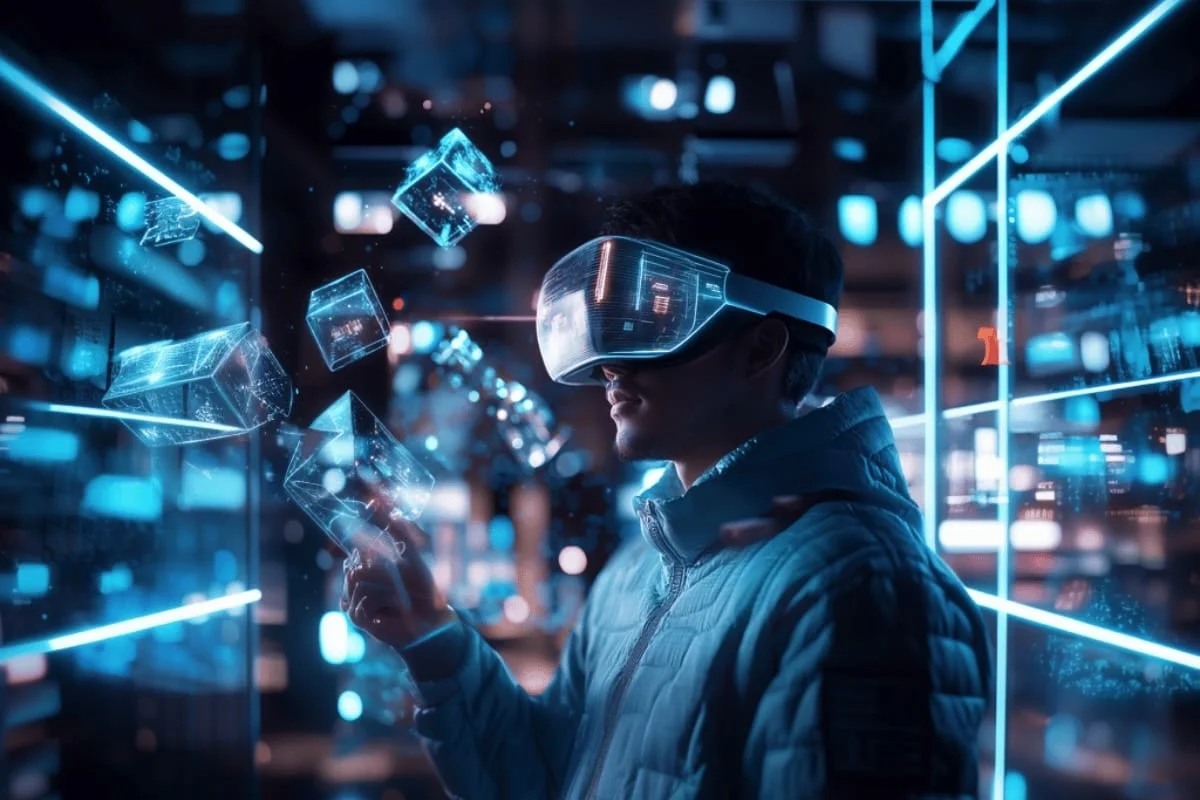
In 2025, augmented reality (AR) isn’t just a buzzword — it’s business-critical. What began as a novelty in gaming and entertainment has matured into a practical tool that’s driving serious results across industries.
Whether you’re designing smarter workflows, reducing product returns, or creating immersive customer experiences, AR is no longer “the future” — it’s the present. From product design studios to global retailers, teams are turning to AR to bridge the gap between digital potential and real-world performance.
Key Takeaways
- AR improves customer interaction and brand engagement
- It’s making operations in manufacturing safer and more efficient
- Marketers use AR to create immersive, memorable content
- Healthcare and education benefit from visual learning and simulation
- AR adoption is growing, making it a vital investment for modern brands
What is Augmented Reality?
Augmented reality (AR) is a technology that enhances your view of the real world by overlaying digital content — like images, instructions, animations, or data — onto physical surroundings.
Unlike virtual reality (VR), which replaces the physical environment entirely, AR works alongside it. That makes it ideal for hands-on applications like product previews, assembly instructions, or real-time diagnostics.
In 2025, AR is more accessible than ever. What once required expensive headsets now runs smoothly on smartphones, tablets, and web browsers.
Benefits of Augmented Reality Across Industries
1. Customer Engagement That Feels Personal
AR gives customers the power to interact with your product in their space. Whether trying on glasses or placing a virtual sofa in their living room, this hands-on preview builds confidence and boosts conversion rates.
2. Real-Time Data and Instructions
In manufacturing and logistics, AR overlays instructions or metrics directly onto equipment. Workers can follow complex tasks with fewer errors.
3. Hands-Free Operation
With AR glasses or tablets mounted for hands-free use, teams in the field — engineers, healthcare workers — can access critical data without pausing the job at hand.
4. More Personalized Marketing
AR lets brands create interactive ads, gamified experiences, or product demos that react to the user’s input.
5. Faster Visual Decision-Making
In product development or home improvement, AR lets users visualize options instantly — reducing delays, indecision, and returns.
Benefits of Augmented Reality in Manufacturing
Step-by-Step Assembly
AR can guide workers through complex builds with real-time, visual instructions overlaid onto machinery.
Predictive Maintenance
Technicians use AR to see diagnostics in context — right on the equipment — before something breaks down.
Quality Control in Real Time
AR systems flag deviations during assembly by comparing the live object to the ideal 3D model.
Safer Workflows
AR signals warnings, visualizes hazards, or guides users through emergency protocols.
Remote Expert Support
An offsite engineer can “see” what a technician sees through AR and guide them through repairs without flying in.
AR for Marketing and Retail: More Than a Gimmick
Virtual Try-Ons
From sunglasses to sofas, AR lets consumers “try before they buy” using only a phone.
Product Visualization
Retailers bring static product pages to life with rotatable, scalable 3D versions of products in their environment.
Interactive Packaging
AR-enabled packaging lets customers scan a product and unlock bonus content — tutorials, recipes, brand stories, or exclusive offers.
AR Showrooms
Skip physical showrooms — showcase an entire collection virtually, anywhere your customer has internet access.
AR in E-Commerce: Driving Better Product Experiences
Try-Before-You-Buy
AR lets users see how a product fits into their life — literally. Visualize a lamp on a bedside table or test how sneakers look on their feet.
Product Exploration
Interactive 360° views and life-size scaling help customers understand the true look and feel of a product.
Impact on Returns
By providing clarity upfront, AR reduces buyer’s remorse — and return rates. Brands using AR can see up to 94% higher conversion rates than those who don’t.
Advantages of AR in Healthcare and Education
Healthcare: Training & Treatment. In surgical settings, AR helps doctors visualize a patient’s anatomy in real-time, overlaying critical data during procedures. Medical students benefit from AR-based simulations.
Patient Education. AR helps patients understand diagnoses and treatment plans.
Education: Beyond Textbooks. AR in classrooms brings subjects to life — letting students interact with 3D models of planets, historical sites, or biological systems.
Remote Learning & Training. AR adds a layer of interactivity that traditional video calls lack.
AR Challenges and the Future Ahead
Hardware and Accessibility. AR relies on capable hardware — mainly smartphones and tablets today. Wearables like AR glasses are gaining ground but cost and availability limit reach.
Development Costs. High-quality AR experiences require specialized skills. Platforms like WebAR and toolkits like Unity make it easier to get started without heavy investment.
User Adoption. Adoption varies by demographic and industry. Usage continues to grow, especially among younger, mobile-first audiences.
Data and Privacy Concerns. Clear permissions, ethical design, and compliance with data regulations are essential.
The Road Ahead. AR will evolve rapidly through AI integration, real-time personalization, and hardware improvements.
FAQs
Why is augmented reality successful? AR seamlessly blends the digital and physical worlds, offering immersive, interactive experiences that engage users on a deeper level.
What is the impact of augmented reality? AR enhances customer engagement, drives higher conversion rates, and reduces return rates in eCommerce by allowing customers to make more informed purchasing decisions.
What is the power of augmented reality? AR has the unique capability to enhance reality by overlaying digital information onto real-world environments.
What problems does augmented reality solve? In retail, AR addresses online shopping uncertainty. In healthcare, it helps surgeons visualize complex procedures. In manufacturing, it improves efficiency and accuracy.
How does AR benefit businesses? Augmented reality improves customer engagement, supports better product decision-making, enhances learning experiences, and boosts operational efficiency.
What’s the difference between AR and VR? AR overlays digital content onto the real world. VR immerses users in a completely virtual environment.
Is AR useful for eCommerce? Absolutely. AR gives online shoppers the ability to see how products look or fit in real-world contexts.
Bring Your Vision to Life with AR Product Rendering
Augmented reality is helping businesses elevate how they design, demonstrate, and deliver products. Explore our AR Product Rendering Services and discover how photorealistic visuals can transform your sales and storytelling.